
Improved housing, sanitation, and healthcare have significantly increased human life expectancy, and biomedical advances have the potential to extend people’s lives further. The life expectancy of a person born in 1860 was only about 39 years; a person born today can expect to live about 79 years. Now some researchers are studying whether altering humans’ senescent cells could increase lifespans even more.
Cellular senescence – a process by which cells stop replicating after a set amount of time – is vital to prevent devastating cancers but also contributes to age-related diseases. Every time a cell replicates, its DNA accumulates a low number of errors. If cells replicate unchecked, these errors can snowball, forming masses of non-functioning cells that damage healthy tissues. For example, the cells responsible for malignant cancers, which can be deadly, do not show any sign of senescence. On the other hand, senescent cells, which are alive but no longer dividing, can build up in a person’s tissues, release harmful chemicals, and contribute to age-related health issues.
Studies – Reducing the number of senescent cells in peoples’ bodies could extend human lives. Studies in mice have shown that removing senescent cells can help mice live longer and maintain their physical abilities. Treated mice lived, on average, 36 percent longer than mice that retained senescent cells. Furthermore, old mice that were given a drug that reduces the number of senescent cells were able to survive COVID-19 in significantly higher numbers than old mice not given the drug. While these results are promising, whether the results can be reproduced in humans is an open question. However, several early human trials are testing drugs that reduce populations of senescent cells targeting specific diseases, such as age-related macular degeneration, glaucoma, and chronic obstructive pulmonary disease. We are already seeing positive results from the early studies, and presently, when using the most common combination, Dasatinib and Quercetin (referred to as D&Q), the studies show little to no side effects.
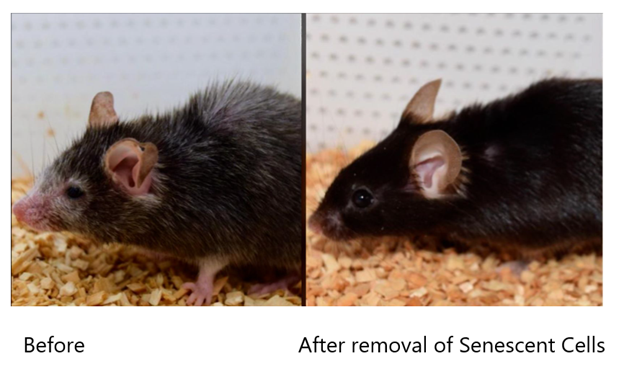
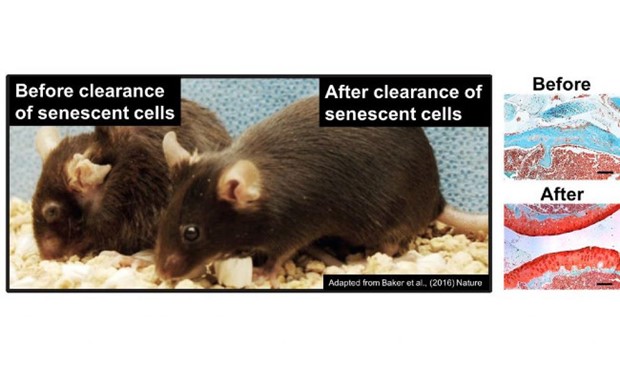
If senescent cells in an aging body are bad, removing them should be good. To test this idea, Darren Baker, a molecular cell biologist at the Mayo Clinic, devised a way to kill senescent cells in mice. Baker genetically engineered mice so that when their cells turned senescent, those cells became susceptible to a certain drug. The researchers began injecting the drug twice a week once the mice turned one year old—that’s about middle age for a lab mouse.
Treated mice maintained healthier kidney, heart, muscle, and fat tissue compared with untreated mice. Though they were still susceptible to cancer, tumors appeared later in life, the researchers reported in studies in 2011 and 2016. The rodents also lived, on average, five or six months longer.
These results generated plenty of interest, Baker recalls and set senescence biology on the path toward clinical research. “That was the boom—a new era for cellular senescence,” says Viviana Perez, former program officer for the SenNet consortium at the National Institute on Aging.
Baker followed up with a study of mice that had been genetically modified to develop characteristics of Alzheimer’s. Getting rid of senescent cells staved off the buildup of toxic proteins in the brain that are seen in this form of dementia. He reported that it helped the mice to retain mental acuity, as measured by their ability to remember a new smell.
There are now a series of ongoing human trials targeting the destruction of senescent cells. In one clinical trial, 64 male volunteers over the age of 36 were dosed with D&Q with the goal of monitoring changes in a stair ascension test and resting systolic blood pressure; both of which showed statistically significant improvements in just 10 days. The study suggests that the D&Q combination is highly likely to be beneficial and with a low side effect profile.
In another study, D&Q was administered in an intermittent-dosing regimen based on the idea that the combination quickly eliminates senescent cells, and it takes several weeks for the body’s tissues to generate new ones. In people with diabetic kidney disease, three days of treatment with DQ reduced senescent cell numbers and inflammation in adipose tissue biopsies taken 11 days later (Hickson et al., 2019; Hickson et al., 2020).
UConn Health scientists discovered that eliminating old, dysfunctional—senescent—cells in human fat can alleviate characteristic signs of diabetes. Their studies showed that using D&Q as a treatment to target a particular population of senescent cells in immunodeficient mice carrying human fat implants eliminated the adverse effects of the fat tissue.
The team claims the discovery could lead to new treatments for type 2 diabetes and other metabolic diseases. “These drugs can make human fat healthy, and that could be great,” said research lead Ming Xu, Ph.D., assistant professor at the UConn Center on Aging and the Department of Genetics and genome sciences at UConn Health. “The results were very impressive and cleared the route for potential clinical trials.” They say the finding that the ability to alleviate the negative effects of fat on metabolism was a dramatic result, and if the therapy worked that well in humans, it would be a game-changing treatment for diabetes.
Xu, together with UConn Health scientists Lichao Wang, Ph.D., Binsheng Wang, Ph.D., and colleagues at UConn Health and the Mayo Clinic, are now pursuing the use of the dasatinib and quercetin combination in clinical trials to see if the drugs can improve type 2 diabetes in human patients. “Although these preclinical results were very promising, large-scale clinical trials are critical to examine the efficacy and safety of these drugs in humans before clinical use,” emphasized Xu.
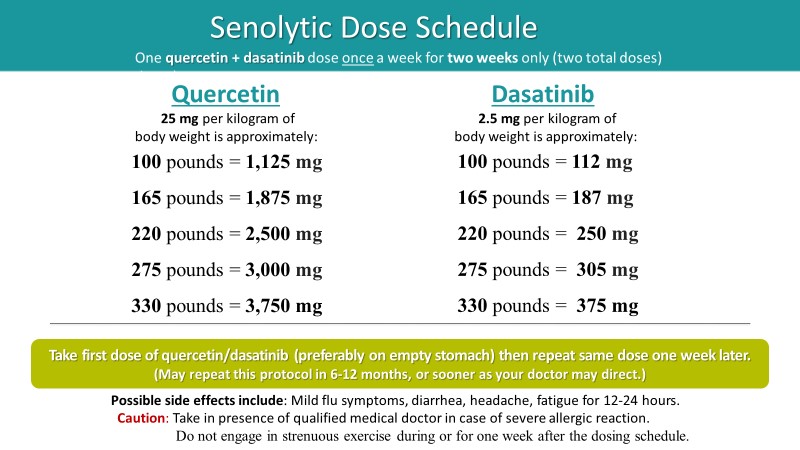
Pricing: Four tablets typically cost $2,200 in the United States. This provides two doses (160 mg each) to be taken one week apart for only two consecutive weeks.
Lower Cost Alternative: Compounding pharmacies offer dasatinib for around $200. (Doctor’s prescription is needed in either case.)
At OB Men, we are the first in Houston to offer this cutting-edge anti-aging therapy. We utilize the first commercially available formulation of D&Q through a Texas-licensed compounding pharmacy. The treatment for six months averages $200, vs. paying over $2,000 for brand-name.
When considering this therapy, it is imperative to understand that detailed claims of anti-aging cannot be made based on currently available studies. However, when taken at the recommended dose outlined above, this treatment carries great promise for anti-aging enthusiasts willing to consider early adoption in a potentially ground-breaking anti-aging treatment. Furthermore, it appears to be safe.
To get D&Q and to discuss other anti-aging and wellness services, reach out to OB Men to schedule a virtual or in-office consultation.