
One of the most frustrating parts of being an athlete or a man who exercises regularly is the constant recovery from nagging muscle, tendon, or ligament injuries. It always takes longer than you expect and is a saga of improvements and setbacks over and over again that can drive any athlete crazy. As someone who has personally dealt with the effects of recurring tennis elbow and an Achilles tendon injury, I am all too familiar with the traditional medicinal approach including NSAIDs, Steroids, physical therapy, and in severe cases narcotic pain meds and or surgery. Fortunately, we are entering a new era whereby we can turn our bodies own healing mechanisms to improve, and sometimes permanently address the injury.
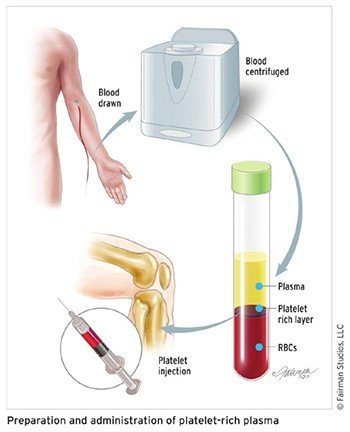
The emergence of regenerative medicine is coming on quickly. Every month new clinic trials throw more support for this approach. Although it has been around for more than a decade, “platelet-rich plasma (PRP)” is gaining stronger support as a treatment option. Platelets are small cells in our blood. They have 2 main functions; to form the clotting cascade, and to oversee the regeneration of injured tissues. Think of when you were a kid riding your bike and scraped your knee. Initially, some blood would come out, but quickly the blood clotted, or you would continue to bleed. Then, a scab would form. If you are like me, your mother would say, “don’t pick at the scab.” Of course, as a curious young boy, I often defied my mother’s advice. Underneath the scab, you’d notice yellow oozing material. That material consists of concentrated platelets, white blood cells, and activated stem cells. In time the skin, surface nerves, and even the subcutaneous fat would regenerate. Using the analogy of a construction site, think of the platelets as the planning engineers. They coordinate the project, bring in the proper construction crew, the building materials, and oversee its completion. Moreover, in thousands of peer-reviewed studies, PRP is safe.
Early studies showed that when PRP is injected near non-healing wound sites in diabetic patients, the healing process was improved. Fast forward more than a decade later, and there are a plethora of studies where PRP is being used in soft tissue injury such as tendonitis, to advanced osteoarthritis in knees, and even in carpal tunnel. In some cases, stem cell treatments may be combined with PRP for a maximum effect.
At OB Men, we have been performing ultrasound-guided PRP soft tissue injuries for years. We are on the cutting edge using the latest proven equipment to maximize platelet concentrations. Some practices claim PRP treatments but may be lacking technique, protocol, or state of the art equipment.
Dr. Darryl Camp is well respected by his male clientele for his dedicated commitment to men’s health and aesthetics. Dr. Camp is Boarded in Neurology, has been a principle investigator in a number of NIH and industry-sponsored trials, and has managed pain patients for years.